Introduction
In developing aerospace structures, precision medical implants, or core components for high-performance automation equipment, engineering teams face a critical dilemma: the more optimized and geometrically complex a design becomes, the less predictable its manufacturing process is. Traditional multi-operation, multi-fixture machining leads to unpredictable cumulative errors, lengthy production cycles, and ultimately, severe risks of budget overruns and project delays. This manufacturing bottleneck stifles innovation and compromises product performance.
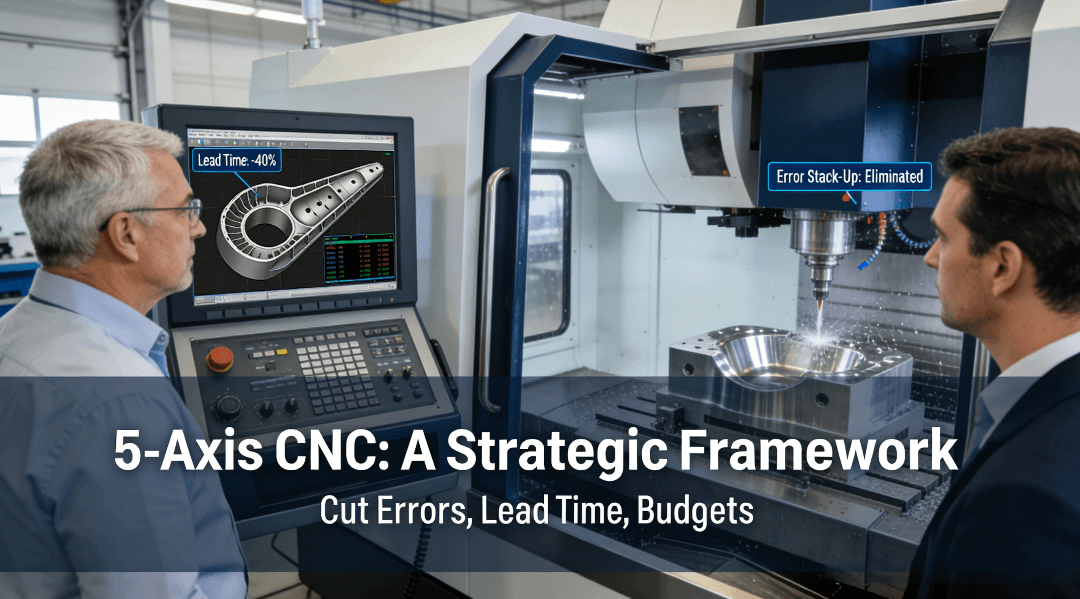
The root cause is forcing three-dimensional, highly integrated designs into a series of discrete, low-freedom manufacturing steps. Each time a workpiece is transferred and re-clamped, a new opportunity for error is introduced, making precision, efficiency, and cost conflicting objectives. This article reveals how 5-axis CNC machining transcends the simplistic view of a “flexible machine” to become a strategic tool for systematic error elimination and process compression. It will build a framework demonstrating how complex geometries can be completed in a single setup, fundamentally locking in positional relationships between critical features, drastically compressing supply chain steps, and achieving predictable project cost and timelines.
What is the True Cost of “Hidden” Errors Accumulated Across Multiple Manufacturing Setups?
Multi-setup machining imposes a significant, often hidden cost through the compounding accumulation of errors. Each fixture change introduces potential datum misalignment and workpiece deflection, which are magnified across sequential operations. This chain reaction leads to out-of-tolerance parts, increased scrap, and necessitates costly inspection and rework. To compensate for this inherent variability, engineers may over-specify tolerances, driving up machining and verification costs unnecessarily. As research indicates, reducing the number of setups in a process is one of the most effective means to lower quality variation and improve product consistency, which is a foundational advantage of 5-axis technology.
- The Domino Effect of Datum Stack-Up and Misalignment: In a 3-axis process, a part may be machined on the top, flipped, and then machined on the bottom. Even with a precision fixture, minute misalignments occur. For a complex part requiring five setups, these micro-errors stack, potentially pushing the final assembly out of specification. The most damaging cost is not just a single scrapped part; it can be the loss of an expensive raw material billet after dozens of hours of machining. A single-setup 5-axis process eliminates these interfaces, machining all features relative to one unchanging datum, which is the bedrock of achieving high-tolerance relationships between complex features.
- Quality Degradation from Repeated Handling and Fixturing: Each time a part is manually handled, unclamped, moved, and re-clamped, it risks cosmetic damage, induced stress, or slight distortion. Furthermore, complex custom fixtures, while necessary for multiple setups, can apply clamping forces that warp thin-walled sections. This handling and fixturing not only adds time but also introduces quality variables that are difficult to predict or control. The one-and-done approach of 5-axis machining minimizes this handling, reducing the risk of handling-induced defects and ensuring the part’s integrity is maintained from the first to the last cut, directly enhancing overall quality control.
- The Economic Burden of Compensatory Over-Engineering: Anticipating errors from multiple setups, designers and engineers are often forced to over-engineer A non-critical dimension might be specified at ±0.025mm in the hope that the final stack-up will still be within a functional ±0.05mm. This over-tolerancing has an exponential cost, requiring slower machining, specialized tooling, and 100% inspection. By guaranteeing feature relationships through precise machine kinematics rather than successive setups, 5-axis machining allows for the specification of functional, rational tolerances. This prevents wasteful expenditure on unnecessary precision, directly contributing to cost control and more efficient precision manufacturing.
How Does Simultaneous 5-Axis Motion Unlock “Unmachinable” Geometries in a Single Operation?
Simultaneous 5-axis motion enables a qualitative leap from machining discrete features to continuously sculpting complex forms. It solves specific engineering nightmares by dynamically tilting the cutting tool to maintain the optimal orientation relative to a complex surface throughout the toolpath. This allows for the machining of negative draft angles and undercuts without special fixtures, enables efficient flank milling with the side of the tool, and permits the use of shorter, stiffer tools to machine deep cavities without chatter. This capability transforms manufacturing from a series of disconnected operations into a fluid, single-process creation of organic, high-performance geometries.
1. Conquering Undercuts and Continuous Contours
Features like the dovetail root of a turbine blade or complex internal manifolds were once considered “unmachinable” in one piece, requiring assembly. With simultaneous 5-axis motion, the tool can tilt to access these negative angles, machining them as a seamless extension of adjacent surfaces. This is not merely about access; it’s about optimal toolpath generation. Advanced CAM software calculates a path where the tool’s cutting edge maintains constant engagement, preventing gouging and ensuring a smooth, accurate finish on the most challenging complex part 5-axis machining contours, directly enabling designs that were previously impossible.
2. Optimizing Tool Engagement for Superior Surface Finish and Longevity
On complex, doubly-curved surfaces, a 3-axis machine using a ball-nose end mill must take tiny steps. The very tip of the ball, where cutting speed is zero, often rubs and burns the material, degrading surface finish. In 5-axis machining, the tool can be tilted, presenting its more effective side-cutting edge to the surface. This “cutting with the side” technique provides higher effective cutting speeds, better chip evacuation, and a superior surface finish. It also distributes wear along a longer section of the tool’s edge, dramatically extending tool life and reducing cost per part, especially in hard, expensive materials.
3. Enabling Stable Machining of Deep Cavities and Thin Walls
Deep pockets or tall, thin-walled features are prone to vibration when machined with long-reach tools, leading to poor finish and potential tool breakage. 5-axis technology mitigates this by allowing the workpiece to be tilted. This presents the side wall to the spindle in a more favorable orientation, enabling the use of a much shorter, more rigid tool to reach the bottom of a cavity. This allows for higher feed rates, eliminates chatter, and enables the production of delicate features with high accuracy. This aspect is crucial for understanding the full scope of how 5-axis CNC machining works to solve stability challenges inherent in advanced designs.
From Aerospace Monolithic Structures to Medical Implants: Where Does 5-Axis CNC Deliver Maximum ROI?
Maximum return on investment for 5-axis CNC is realized in applications where geometric complexity, structural integration, and performance are paramount. In aerospace, it enables the manufacture of monolithic structures like blisks (bladed disks) and complex airframe brackets, consolidating assemblies into single, lighter, and more reliable components. In medical device manufacturing, it produces patient-specific titanium implants with porous surfaces for osseointegration and mold inserts with conformal cooling channels. These cases highlight its role in enabling part consolidation, weight reduction, and functional integration impossible with traditional methods. A deep understanding of these applications is foundational for effectively planning and evaluating projects. A comprehensive guide to 5-axis CNC machining services, offering engineers a systematic reference for evaluating project suitability and cost structures.
1. Aerospace: Weight Reduction and Structural Integrity
Aerospace engineering relentlessly pursues weight savings without compromising strength. A titanium engine blisk, machined from a single forging, eliminates dozens of dovetails, pins, and bolts, reducing part count and potential failure points. 5-axis machining is the only practical way to create the complex, aerodynamic contours of the blades integrated with the hub in one setup. Furthermore, structural components with optimized lattice structures for stiffness can be machined, achieving exceptional strength-to-weight ratios that are critical for flight performance and fuel efficiency.
2. Medical: Personalization and Biocompatible Complexity
The medical field demands both extreme precision and the ability to create organic, patient-specific shapes. 5-axis machining produces cranial implants or spinal cages that perfectly match a patient’s anatomy from CT scan data. It can create micro-scale surface textures on implants to promote bone growth. For surgical tools, it manufactures intricate, small components with tolerances in the micron range. The ability to work with biocompatible materials like titanium and PEEK, and to achieve the required sterilizable surface finishes, makes 5-axis a cornerstone of advanced customized solutions in medtech and a powerful tool for prototype development.
3. Automotive & Energy: Performance Through Design Freedom
In high-performance automotive and energy sectors, 5-axis machining creates complex conformal cooling channels in injection molds, drastically reducing cycle times and improving part quality. It manufactures intricate fuel injector nozzles and turbine components where fluid dynamics are critical. The technology allows for the design of parts that are not just containers, but highly efficient functional systems. By enabling these optimized designs, 5-axis machining contributes directly to end-product performance, whether it’s a more efficient engine, a longer-lasting mold, or a more powerful energy system, driving engineering innovation.
Why is a “Digital Thread” from CAD to CMM Non-Negotiable for High-Precision 5-Axis Work?
The success of complex 5-axis machining is critically dependent on a seamless digital thread connecting every stage from design to verification. This integrated data flow prevents the catastrophic translation errors that can occur with intricate parts. It begins with the 3D CAD model, used by advanced CAM software to generate optimized, collision-free toolpaths. This program is then validated in a digital twin simulation. Finally, the finished part is measured with a CMM or 3D scanner, and the data is compared directly to the original CAD model, completing the quality assurance loop. This end-to-end digital process is the practical implementation of robust quality assurance in transforming industrial design into a high-precision physical component.
1. Advanced CAM: The Brain Behind Complex Motion
Programming a 5-axis machine is exponentially more complex than 3-axis. Advanced CAM software is non-negotiable. It doesn’t just plot points; it calculates the continuous, synchronized movement of all five axes to maintain the correct tool orientation. It employs strategies like tool axis tilting to avoid collisions and smooth interpolation to prevent jerky movements. The software acts as the essential translator, converting design intent into a safe, efficient machine language that leverages the full potential of simultaneous 5-axis motion, ensuring the digital design is faithfully executed.
2. Simulation: The Virtual Prove-Out That Prevents Physical Disaster
Given the complexity and cost of 5-axis parts, a physical “prove-out” is prohibitively risky. Virtual simulation software creates a digital twin of the machine, tooling, fixture, and part. The entire program is run in this virtual environment to detect potential collisions between the toolholder and the part or fixture, and to verify that the toolpath matches the design. This step is the ultimate insurance policy, preventing tens of thousands of dollars in damage to both the part and the machine, and is a critical component of a modern, reliable manufacturing workflow.
3. Metrology: Closing the Quality Loop with Data-Driven Proof
The final, critical link in the digital thread is precision metrology. A part with complex free-form surfaces cannot be verified with hand tools. A Coordinate Measuring Machine (CMM) with a scanning probe captures millions of data points from the physical part, creating a point cloud. This cloud is then statistically compared to the nominal CAD model, generating a color-map that visually shows deviations, often within microns. This report provides objective, data-driven proof of conformity, fulfilling stringent quality requirements and providing the confidence needed for high-stakes applications in aerospace and medical fields. This closed-loop process is what defines modern precision manufacturing.
How to Decode a 5-Axis CNC Machining Quote: Moving Beyond Hourly Rate to True Project Cost?
A true assessment of a 5-axis machining quote requires looking beyond the hourly machine rate to analyze the Total Cost of Ownership (TCO). The evaluation must account for eliminated secondary operations, reduced fixture costs, lower scrap rates, and the strategic value of a compressed time-to-market. A project with high “complexity density” — where many challenging features are integrated into a single component — will typically see a favorable cost-benefit ratio. A pragmatic framework involves quantifying these often-overlooked savings to build an accurate business case and understand how to get a CNC machining quote that reflects true value, not just hourly cost.
1. Quantifying the Savings from Process Consolidation
The most direct savings come from eliminating process steps. List every operation a traditional 3-axis approach would require: milling top, fixture design #1, milling side A, fixture design #2, etc. Each step has a cost in programming, setup, machine time, and labor. 5-axis machining consolidates these into one (or significantly fewer) steps. It also eliminates the need for complex custom fixtures, as the part’s orientation is achieved through machine rotation. The cost of designing and machining these fixtures can be substantial and is entirely saved, a key factor often missing from simplistic rate comparisons.
2. Factoring in Quality Gains, Risk Reduction, and Time Value
Improved first-pass yield is a major financial benefit. Reduced setups mean fewer chances for error, leading to lower scrap rates. Higher accuracy and better surface finish from optimized tool paths can also reduce or eliminate secondary bench work (hand finishing, polishing). This not only saves money but also reduces project risk and accelerates the timeline. The weeks saved by 5-axis machining translate directly into revenue opportunity and earlier market entry. This reliability and speed are critical, yet often unquantified, components of the overall value proposition in a 5-axis CNC machining quote.
3. Evaluating the Quote for Holistic Value, Not Just Line Items
When reviewing quotes, demand transparency. A detailed quote should break down material cost, machine time/engineering, and tooling/setup. Compare not just the bottom line, but the assumptions behind each line. Does one supplier’s quote include all required post-processing? Does another assume a less efficient machining strategy that inflates time? Understanding these details allows for an apples-to-apples comparison. The goal is to partner with a supplier whose quote reflects a deep understanding of efficient customized solutions for your specific part, not just a generic service offering.
What Systemic Capabilities Separate a True Manufacturing Partner from a Machine Shop?
Selecting a 5-axis partner requires evaluating systemic capabilities and engineering culture, not just machinery. The right partner possesses deep application engineering expertise for complex toolpath planning and collision avoidance. They operate within a robust quality management system (like IATF 16949) ensuring traceability and process control. Crucially, they demonstrate proactive collaboration, engaging in DFM discussions and providing transparent communication. For mission-critical components, this holistic system is more vital than any single machine’s specs. Following industry-specific quality standards is fundamental to ensuring part reliability and is a core criterion for evaluating a capable partner.
- Depth of Process Engineering and Proactive Problem-Solving: A partner’s true value is revealed in their engineering team’s depth. Can they discuss the trade-offs between different 5-axis machine configurations for your part? Do they have proven strategies for machining challenging features in your specific material? Look for evidence of complex project experience — case studies or a willingness to walk you through a similar past challenge. Their engineers should act as an extension of your team, asking “why” a feature is designed a certain way to suggest a more manufacturable and cost-effective alternative. This depth transforms them from a job shop into a true 5-axis CNC manufacturer.
- A Certified and Lived Quality Culture: Certifications are a baseline; a true quality culture is lived daily. Inquire about their First Article Inspection (FAI) process, in-process inspection protocols, and how they manage corrective actions. A partner invested in quality will be transparent, readily sharing sample inspection reports from CMMs. For regulated industries, their understanding and adherence to standards like IATF 16949 is non-negotiable. This systemic approach to quality is what guarantees that the thousandth part is identical to the first, which is the essence of reliable production for 5-axis CNC machining parts manufacture.
- Strategic Alignment and Transparent Collaborative Workflow: Finally, assess the collaborative dynamic and strategic fit. Is their communication proactive with a single point of contact? The best partners view the relationship strategically, invested in your long-term success. They should be capable of guiding you seamlessly from prototype to production, offering insights on design, material selection, and post-processing. Their goal should be to make your project succeed. This partnership model, built on trust, transparency, and shared technical goals, is ultimately what transforms a complex design into a reliably manufactured, high-performance component, fulfilling the promise of a true development partner for precision 5-axis CNC machining.
Conclusion
5-axis CNC machining for complex components has evolved from an “advanced capability” into a strategic framework for systematic risk management and process optimization. By eliminating multi-setup errors, enabling unprecedented design integration, and relying on a robust digital quality thread, it provides a clear path to resolving the classic trade-offs between precision, efficiency, and cost. Mastering and strategically implementing this approach enables engineering teams to transform manufacturing from a project bottleneck into a core competitive advantage, bringing groundbreaking, reliable products to market faster and more predictably.
FAQs
Q: What are the most common types of parts that justify the use of 5-axis CNC machining?
A: Parts with complex 3D contours, undercuts, deep cavities, or multi-angle features benefit most. Examples include turbine blades, impellers, aerospace brackets, molds, and medical implants. Any component requiring multiple setups on a 3-axis machine — introducing alignment errors and delay — is a prime candidate. The technology excels at consolidating processes and machining difficult-to-access geometries in a single, accurate setup.
Q: Is 5-axis machining always more expensive than 3-axis machining?
A: Not on a total project cost basis. While the hourly rate is higher, 5-axis can be more cost-effective for complex parts. It eliminates multiple fixtures, reduces handling/setup time, minimizes inter-operation errors, and often achieves a better finish faster. For simple parts, 3-axis is cheaper. The benefit shifts when geometry allows significant reduction in secondary operations and overall project duration.
Q: What information do I need to provide to get an accurate 5-axis CNC machining quote?
A: Provide a 3D CAD model in STEP or Parasolid format and a detailed 2D PDF drawing. The drawing must specify critical dimensions, geometric tolerances (GD&T), material, surface finishes, and quantities. Clear, complete documentation allows for an accurate assessment of manufacturability and cost without unnecessary clarification delays.
Q: How is the accuracy of a complex 5-axis machined part verified?
A: Accuracy is verified using high-precision metrology. The gold standard is a Coordinate Measuring Machine (CMM) that compares the part directly to the original 3D CAD model, generating a comprehensive deviation report. For first-article inspection, a detailed FAIR is provided. In-process verification on the machine using touch probes is also common for production runs to ensure consistency.
Q: Can 5-axis machining be used for both prototyping and production?
A: Absolutely. It is invaluable for both. For prototyping, it creates high-fidelity, functional prototypes from production materials rapidly. For production, it enables efficient manufacturing of complex end-use parts, especially in low to medium volumes where hard tooling is not justified. The same digital workflow ensures a seamless transition from prototype to production.
Author Bio
The author is a specialist in precision multi-axis machining applications, with over 15 years of experience helping clients solve high-complexity, tight-tolerance component challenges. Their expertise is applied within the framework of LS Manufacturing, a precision engineering partner dedicated to providing integrated manufacturing solutions from design optimization to volume production. The team operates under a certified management system encompassing ISO 9001, IATF 16949, and AS9100D, ensuring systematic quality and full traceability. For a professional DFM analysis and a transparent 5-axis machining quote on your next complex component, explore their comprehensive 5-axis CNC machining capabilities and submit your 3D CAD files for a customized engineering assessment.