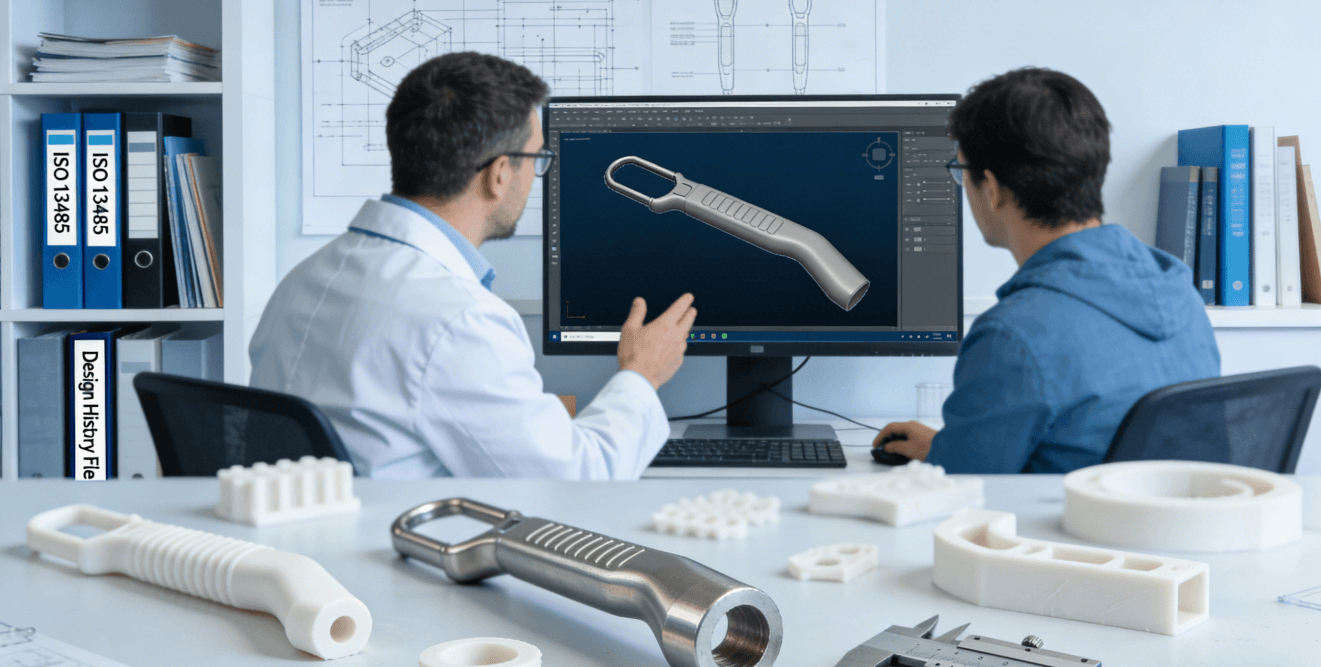
Introduction
For medtech startups and R&D teams, translating an innovative concept into a physical prototype ready for testing and regulatory scrutiny is a critical, high-risk phase. Many teams invest months of effort and significant resources, only to face major setbacks—or even failure—on the eve of animal trials or regulatory submission due to issues with material biocompatibility, design for manufacturability, or documentation traceability.
The root cause often lies in treating “compliance” as a final checklist item rather than a design language integrated from the start. The traditional “design first, verify later” model carries an exorbitant cost in the medical device field. Successful prototype development depends on proactively weaving regulatory expectations (like FDA guidance) and quality system principles (such as ISO 13485) into every decision, from conceptual design to process selection.
Why Do Up to 80% of Medical Device Prototypes Face Major Delays or Failures in the Verification Stage?
Industry analyses frequently reveal that a majority of medical device project delays can be traced back to the prototyping phase. The staggering failure rate at the verification stage is seldom due to a flaw in the core technology but rather a common neglect of the regulatory and quality framework integral to prototyping medical devices.
Three primary reasons stand out. First, is treating FDA prototype guidelines as an afterthought. Teams often design and build prototypes in isolation, only considering Human Factors Engineering (HFE) and usability testing requirements later. This leads to designs that fail to meet end-user needs, forcing costly and time-consuming late-stage redesigns. Second, material selection based solely on mechanical performance, without pre-screening for ISO 10993 biocompatibility standards, can lead to catastrophic failures during toxicological evaluation. Third, a lack of Design for Manufacturability (DFM) analysis results in a prototype that functions in the lab but cannot be reliably or cost-effectively mass-produced.
The consequence of these oversights is expensive design changes that critically derail the entire medical device prototype development timeline, potentially causing a missed market window. This underscores the importance of the risk management principles outlined in standards like ISO 14971, which advocate for integrating risk control measures into the design and development process from the very beginning, not as a retrospective fix.
Beyond Price, What Core Competencies Should Be Evaluated When Choosing a Prototype Development Partner?
Foundational Systems and Regulatory Acumen
A partner’s unwavering commitment to formalized systems is critical for medical device success. This encompasses rigorous standards and traceability to ensure compliance and safety.
- Quality System Certification
Possessing ISO 13485 Medical Devices certification is essential, as it validates a robust quality management system. Further credentials, such as ISO 9001, demonstrate advanced process control and reliability, fostering trust in prototyping and production stages.
- Material and Documentation Integrity
Expertise in certified biocompatible materials is vital, coupled with full traceability from Certificate of Conformity (COC) to final reports. This integrity underpins the Design History File (DHF), aligning with FDA Design Control guidance for thorough documentation and risk mitigation.
The Value of Proactive Engineering Partnership
Top medical device prototyping firms transcend mere fabrication by offering true engineering services. They emphasize proactive collaboration, including early Design for Manufacturability (DFM) analysis to optimize designs, control long-term prototyping costs, and secure a viable production pathway. This shifts focus from “build-to-print” orders to strategic partnerships that enhance innovation and efficiency.
How to Seamlessly Integrate FDA Guidance Requirements from the Earliest Prototype Stage?
A common pitfall is viewing FDA prototype guidelines as a submission checklist. Instead, they should serve as the guiding framework for the entire design process, integrated proactively from the outset.
This integration can be achieved at three key junctions. During conceptual design, low or high-fidelity prototypes should be created specifically for early formative usability testing, informed by FDA’s Human Factors Engineering guidelines, to identify and correct use errors. Material and process selection must be driven by the product’s intended use, nature of body contact, and intended sterilization method, ensuring prototype materials align with final product requirements. Furthermore, all performance specifications and their corresponding verification test methods should be defined in the design input stage, ensuring the subsequent prototype is built for these specific tests.
The primary benefit of this approach is that it front-loads risk mitigation, dramatically reducing the chance of a major design change request from regulators during pre-clinical studies or 510(k) submission. An experienced engineering team that understands the intent behind the FDA prototype guidelines provides invaluable support in this process. For a deeper dive into this integrated approach, a comprehensive guide to medical device prototype development is available for further reading.
What Are Key Strategies for Controlling Prototype Development Cost? Are There Hidden Costs?
The Visible and Hidden Costs of Medical Device Prototyping
Visible costs include medical-grade materials, complex machining, and compliance. The significant hidden cost is iterative rework from oversights, which can cause failed trials, major delays, and immense financial waste.
Effective Cost Control Strategies
Effective control of prototyping costs requires a proactive, strategic partnership. It focuses on preventing the high hidden cost of rework through early design optimization (DFM) and phased validation, rather than merely negotiating lower piece-part prices.
- Phased Prototyping and Early DFM
A phased approach—from 3D printing to CNC prototypes—validates objectives efficiently. Early Design for Manufacturability (DFM) analysis is crucial to optimize design, reduce complexity, and lower costs at the source.
- Transparent Partnership for Accuracy
Partner with prototyping firms that provide clear, itemized quotations. A proficient partner controls total development cost by ensuring accuracy from the start, thereby minimizing expensive rework and delays.
What Does ISO 13485 Certification Truly Mean for the Prototyping Stage? Is It Just a Certificate?
A prevalent misconception is that ISO 13485 Medical Devices certification only matters for volume production. For the medical device prototype phase, it is far from a mere certificate; it is an operational system that ensures a controlled, documented, and reproducible development process.
In practice, an ISO 13485 system for prototyping means every customer requirement (design input) is formally reviewed; every batch of raw material is purchased with traceable certificates; every machine parameter and calibration record is maintained; and every processing step and inspection result for a prototype is fully documented. This ensures the prototype is not just a physical sample, but a reliable carrier of all the technical decisions and process parameters behind it.
The value of these controlled records becomes paramount later. They can be directly compiled into the Design History File (DHF), providing solid evidence for FDA or CE mark submissions and preventing a last-minute scramble for documentation. Therefore, choosing an ISO 13485-certified partner for prototype development is a strategic investment in the product’s entire lifecycle compliance. A partner like JS Precision, which holds ISO 13485 certification, embodies this principled approach, ensuring that prototype development is a foundation for success, not a future liability.
Conclusion
Developing a successful medical device prototype is a precise balancing act between function, compliance, and cost. It sets the rhythm for product launch and can determine its ultimate success or failure. By internalizing the requirements of FDA guidelines and ISO 13485 standards from the very start of the development flow, and by selecting a partner with the corresponding quality system and engineering depth, teams can significantly mitigate technical risk, control development cost, and pave a solid path to market clearance.
Author Bio
The author is a seasoned expert in precision manufacturing and medical device compliance with over 15 years of industry experience. Having assisted numerous startups and large enterprises in bringing medical devices from concept to approval, the author possesses a deep, practical understanding of applying standards like those from the FDA and ISO 13485 during the critical prototyping phase.
FAQs
Q: Must a medical device prototype use the exact same material as the final product?
A: Not necessarily, but it is highly recommended to use materials with similar properties or pre-certified status. This ensures test validity and avoids re-validation risks and costs when switching materials for production.
Q: Does FDA review begin at the prototype stage?
A: While the FDA does not directly review early prototypes, its guidance principles should be integrated throughout. Incorporating FDA expectations for human factors and testing standards during prototyping prevents major late-stage design changes and is key to accelerating time-to-market.
Q: Can a prototyping service provider assist with small-batch pilot production?
A: Yes. Many specialized providers offer integrated services from prototype to pilot production, including DFM optimization, compliance documentation support, and transition to production processes, ensuring a seamless journey from concept to market.
Q: Can a CNC-machined prototype be used for formal compliance testing?
A: Yes, provided three conditions are met: the material has biocompatibility certification, the machining process is validated, and complete traceable documentation is available. Prototypes from an ISO 13485-certified supplier like JS Precision are typically at an advantage here.
Q: How can one estimate the development timeline for a medical device prototype?
A: The timeline ranges from weeks to months, depending on design complexity, technology choices, and iteration cycles. Partnering with a firm that employs concurrent engineering and has an efficient supply chain can maximize time compression, for instance, by using rapid prototyping to validate concepts before moving to precision CNC machining for functional prototypes.