The Evolution of Windsurfing: Equipment, Techniques, and Competitive Events
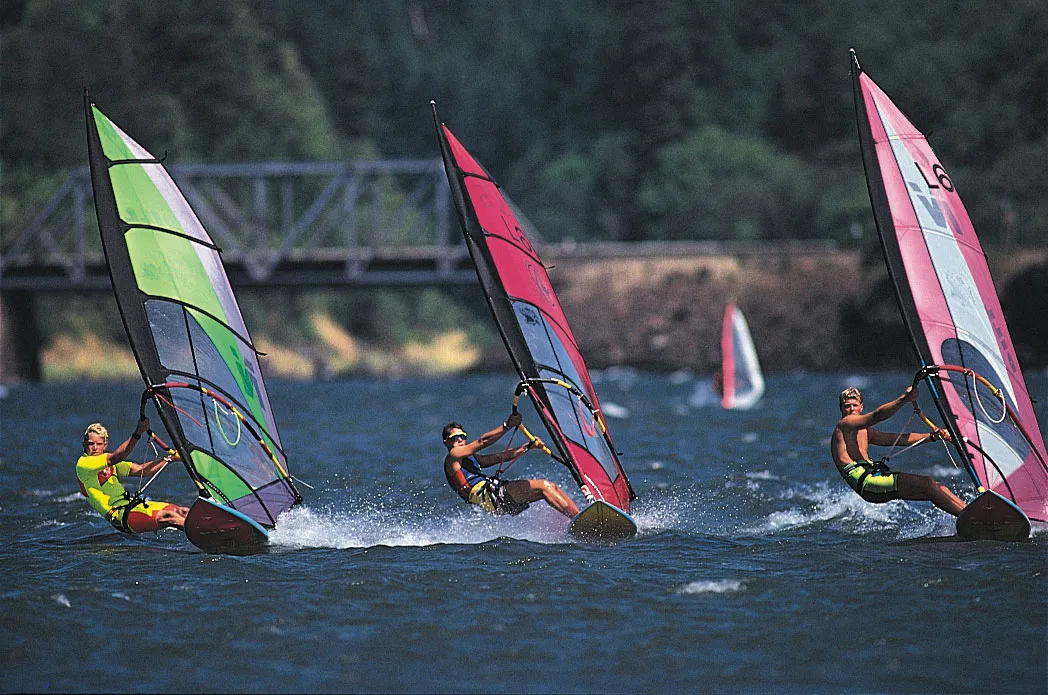
You’ve probably seen windsurfing without really clocking it — someone gliding across a bay, sail tilted at some angle that looks physically wrong, board barely touching the water. Looks easy from the beach. It’s not. And the gear behind it has changed so much in fifty-odd years that someone windsurfing in the 70s would barely recognize what’s racing at the Olympics now.
The whole thing kicked off, roughly, in late-60s California, when Jim Drake and Hoyle Schweitzer patented what they called the “Windsurfer” — a board with a universal joint connecting mast to deck, so the sail could pivot freely in any direction. That joint idea is still the backbone of every rig out there today. People had tried strapping sails onto surfboards before that, sure, but none of it really worked until someone figured out the sail had to move independently from the board underneath it.
The sport spread quickly through the 70s and into the 80s, and made its Olympic debut at Los Angeles in 1984 on a board called the Windglider. Old-school sailing types weren’t thrilled, by the way — one line floating around from back then compared it to swapping a car’s chassis for roller skates. They were wrong, obviously. It kept growing anyway, kept getting faster gear, kept finding new ways to compete.
If you’re the type who tracks a niche sport closely enough to understand the scoring before most people even know the event exists — that same instinct usually carries over to watching the odds too. dbbet tends to list windsurfing and sailing markets during the bigger regattas, worth knowing about if you like following these events as closely as some of us do.
Anyway — back to the boards, because that’s really where the interesting stuff happened.
From daggerboards to hydrofoils
For most of windsurfing’s history, boards used a daggerboard, basically a fin hanging down into the water to stop the board sliding sideways. Worked fine. Also created a lot of drag, meaning you needed proper wind to get moving. The Olympic classes tracked this for decades — Mistral ran from the late 80s through 2004, then RS:X took over from Beijing 2008 all the way through Tokyo 2020.
Then foils showed up and the whole picture shifted again. A hydrofoil is a carbon-fibre wing bolted underneath the board that lifts the entire thing above the water once you hit enough speed. Less water contact, way less drag, way more speed — and, crucially for racing, it works in light wind too. RS:X needed real breeze before it went anywhere. iQFOiL, which took over as the Olympic standard from Paris 2024, gets foiling in conditions where RS:X would’ve just sat there.
The numbers make it pretty obvious. RS:X race starts happened around 5 km/h. iQFOiL athletes start closer to 25 km/h and can top 60 km/h once fully up on the foil. That’s not a small tweak — that’s basically a different sport wearing the same name tag.
Sails, boards, and what actually changed underneath
It’s not just foils, either. Sail design quietly went through its own overhaul — camber-induced sails, the ones with rigid battens holding a fixed shape, replaced soft sails for anyone racing seriously, mainly because they don’t flap around unpredictably in gusty conditions. Board shapes went shorter and wider for slalom racing at one point, then narrower again once foils started handling a lot of the stability job themselves.
There’s also a split now in what “windsurfing” competitively even means. Course racing is upwind-downwind tactics over a fixed track. Slalom’s short, fast, downwind, a little chaotic with riders weaving past each other at close range. Marathon events go the opposite direction — an hour or more of pure endurance, sometimes literally point-to-point between landmarks out on open water. At the Paris Olympics, iQFOiL sailors worked through all three formats across several days before the field got trimmed down to a medal series with quarterfinals and semifinals — a lot more structure than this sport’s ever had at that level.
Technique had to catch up with the hardware
None of this new gear is easier to sail, for what it’s worth — if anything it’s harder. Foiling asks for a completely different sense of balance than a traditional board does. You’re not just leaning against sail pressure anymore, you’re also managing a wing underwater that reacts instantly to the smallest shift in your stance. Plenty of riders who spent years on RS:X had to basically relearn their instincts switching over, and a few veterans have talked pretty openly about how odd that transition felt, even after a decade of racing.
Speed sailing — a separate discipline entirely from Olympic racing — pushes technique even further. Purpose-built speed boards and tiny, low-drag sails exist for one job: going in a straight line as fast as physically possible over roughly 500 meters. Frenchman Antoine Albeau has dominated this corner of the sport for years, chasing outright windsurfing speed records well past 50 knots, numbers that would’ve sounded made up to anyone racing back in the 1980s.
Where the competitive scene sits now
Outside the Olympics, the Professional Windsurfers Association still runs a global tour across slalom, waves, and freestyle, and it’s produced most of the sport’s biggest names over the years. Formula Windsurfing — big boards, huge sails, no foil involved — runs its own world championship circuit and feels almost like a different era compared to anything foil-based, closer to classic planing than flying.
The Olympic side keeps moving too. World Sailing’s already confirmed iQFOiL sticks around for Los Angeles 2028, though the class tweaked its equipment starting in 2025 — smaller sails for both men and women, mainly to make the boards more manageable across different athlete weights and smooth the path from youth into senior competition.
Fifty years in, still evolving
What’s kind of striking, honestly, is how little the core idea has changed since that original patent — a sail on a universal joint, powered by wind and balance and not much else. Everything built on top of that — the foils, the camber sails, the race formats, the sheer speed — is still just a smarter version of one simple trick from a California beach half a century ago. The sport hasn’t gotten any less physical along the way. It’s just found faster ways to do the same basic thing.