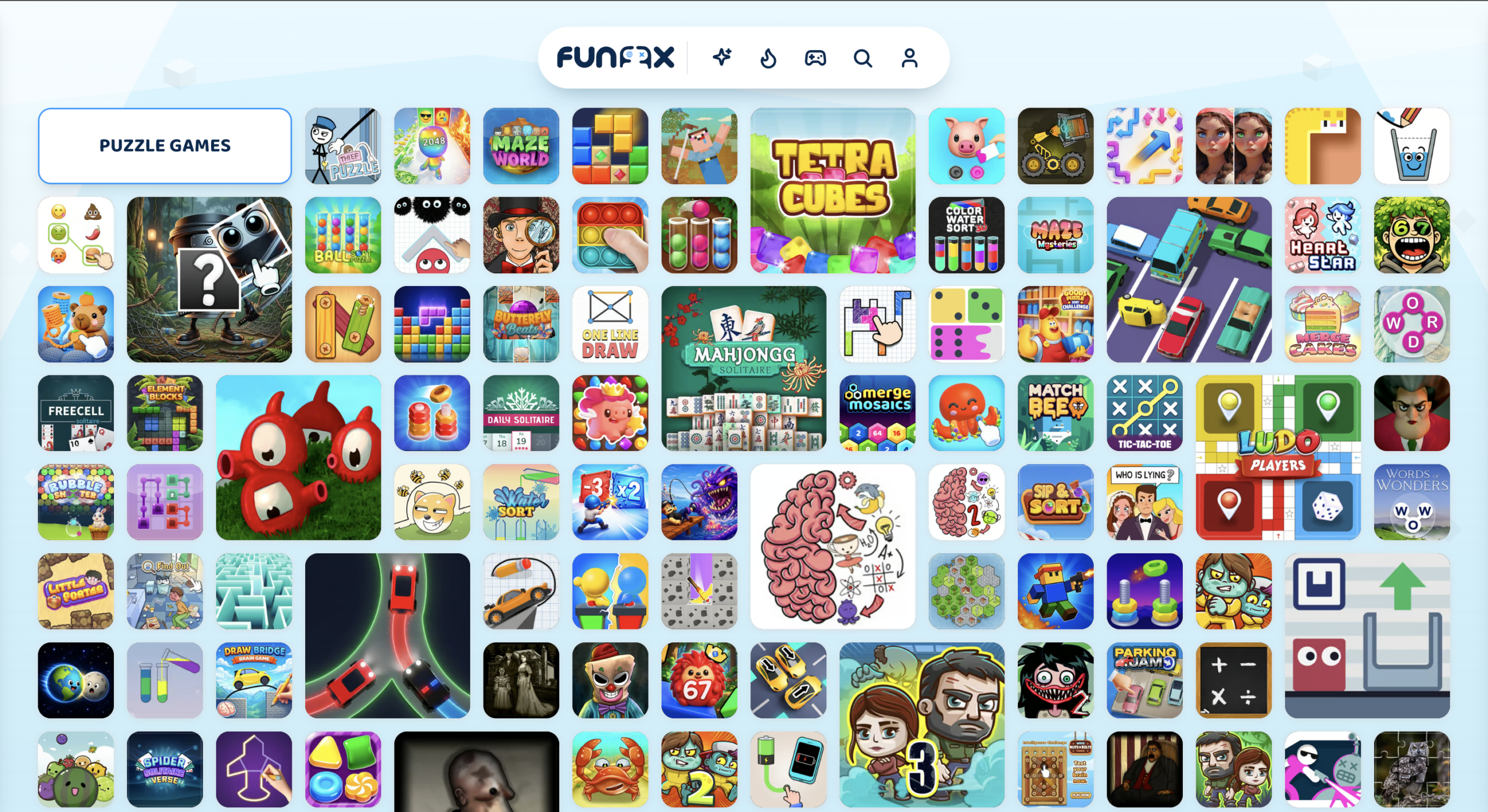
The best puzzle games rarely need a long tutorial. You understand the basic idea within minutes, make a few moves and feel like you have everything under control.
More pieces appear, space becomes limited, obvious solutions stop working and suddenly a simple puzzle demands real concentration. That gradual increase in difficulty is one reason puzzle games work so well for both quick breaks and longer gaming sessions.
From number puzzles to sorting challenges, here are 10 games on Funox that demonstrate how simple rules can lead to surprisingly difficult decisions.
Start With Logic
1. 2048
The idea behind 2048 Games could hardly be simpler: move numbered tiles around the board and combine matching values.
Early combinations come quickly. The real challenge begins when space starts disappearing. Reaching higher numbers requires planning several moves ahead and keeping the board organised.
2. Water Sort
Water Sort replaces numbers with coloured liquids.
Players need to separate colours into individual containers while working with limited available space. The first stages introduce the mechanic gently, but later arrangements require much more careful sequencing.
3. Blocky Blast Puzzle
Blocky Blast Puzzle is another game where available space matters.
Placing blocks looks straightforward until the board begins filling. Good players need to think beyond the current piece and consider how each placement will affect future opportunities.

4. Brain Test: Tricky Puzzles
Brain Test: Tricky Puzzles deliberately encourages players to question what they see.
A problem may appear to have an obvious solution, only for the game to expect a completely different approach. Observation and experimentation can become more useful than applying traditional puzzle logic.
5. Who Is?
Who Is? puts more emphasis on identifying clues and working out what is happening in different situations.
The challenge comes from noticing details that are easy to overlook. Instead of solving mathematical patterns, players have to examine the scene and decide which information actually matters.
6. Arrow IQ: Logic Puzzle
Arrow IQ: Logic Puzzle brings the focus back towards structured reasoning.
Its accessible concept makes the early experience approachable, while increasingly complicated situations force players to think more carefully before acting.

7. Away The Pins!
Away The Pins! presents challenges where the order of actions matters.
Pulling or interacting with the wrong element can change the situation immediately. Later puzzles therefore reward players who study the setup before committing to a move.
8. World Of Screw
World Of Screw turns a straightforward mechanical concept into a sequence of increasingly involved problems.
The player has to work out how different elements interact and determine the correct order for progressing through each challenge.
9. Thief Puzzle
Thief Puzzle uses environmental problem-solving in a more playful way.
Players need to work out how to reach an objective without falling into the traps created by each scenario. The controls may be accessible, but finding a safe solution can require experimentation.
10. Draw Bridge
Draw Bridge asks players to create a route that allows a vehicle to overcome the obstacle ahead.
Players have to consider the environment, the vehicle’s movement and the shape of the route they create. Small changes can produce completely different results, encouraging experimentation rather than relying on a single fixed solution.

Different Games Exercise Different Skills
2048, Water Sort and Blocky Blast Puzzle reward planning and organisation. Brain Test: Tricky Puzzles and Who Is? rely more heavily on observation and unconventional thinking.
Arrow IQ: Logic Puzzle, Away The Pins! and World Of Screw introduce logical sequencing, while Thief Puzzle and Draw Bridge make experimentation an important part of solving the challenge.
Simple Rules Leave Room for Deeper Challenges
Funox offers browser puzzle games alongside brain, logic, casual and other related categories, making it easy to move between different styles of problem-solving.
They do not make players spend twenty minutes learning how to play. They introduce a clear problem, give the player enough information to begin and gradually make that familiar idea more demanding.